Payment Cards: Architectural Framework, Card Types, and Transaction Security

NezenX Team
Most payment cards share familiar details: a card number, an expiry date, and a security code. Behind that format, though, cards differ in where the money comes from and which networks they use. These differences affect how spending is managed and where a card is accepted.
This guide explores the evolution of payment cards, their main types, the networks they use, and how transactions are processed and secured.
Overview & The Physical-to-Digital Evolution
A payment card is a payment instrument issued by a financial institution that allows its holder to use an account balance, prepaid funds, or credit provided by the issuer to make financial transactions in person or online.
For much of their history, payment cards have existed primarily in physical form. Physical cards commonly follow the ID-1 format defined by ISO/IEC 7810, helping them fit compatible card readers and ATMs. Early cards carried embossed details, such as the card number, cardholder’s name, and expiry date, that merchants imprinted onto paper slips to record a transaction.
Magnetic stripes later allowed terminals to read card information electronically, replacing the need to imprint it onto paper. But the data on a magnetic stripe could be copied and used to create counterfeit cards. EMV chips helped address this risk by generating a unique security code for each transaction, making copied data harder to reuse. Contactless EMV technology also allows cardholders to pay by tapping a card at a compatible terminal instead of inserting it.
Today, a virtual card can be used for online payments without a physical card. Some can also be added to a digital wallet for contactless purchases. For businesses, some virtual card programs support separate cards and spending controls for different vendors or teams, helping them manage individual budgets and limit exposure if one card’s details are compromised.
Funding Mechanisms: Choosing the Right Card Type
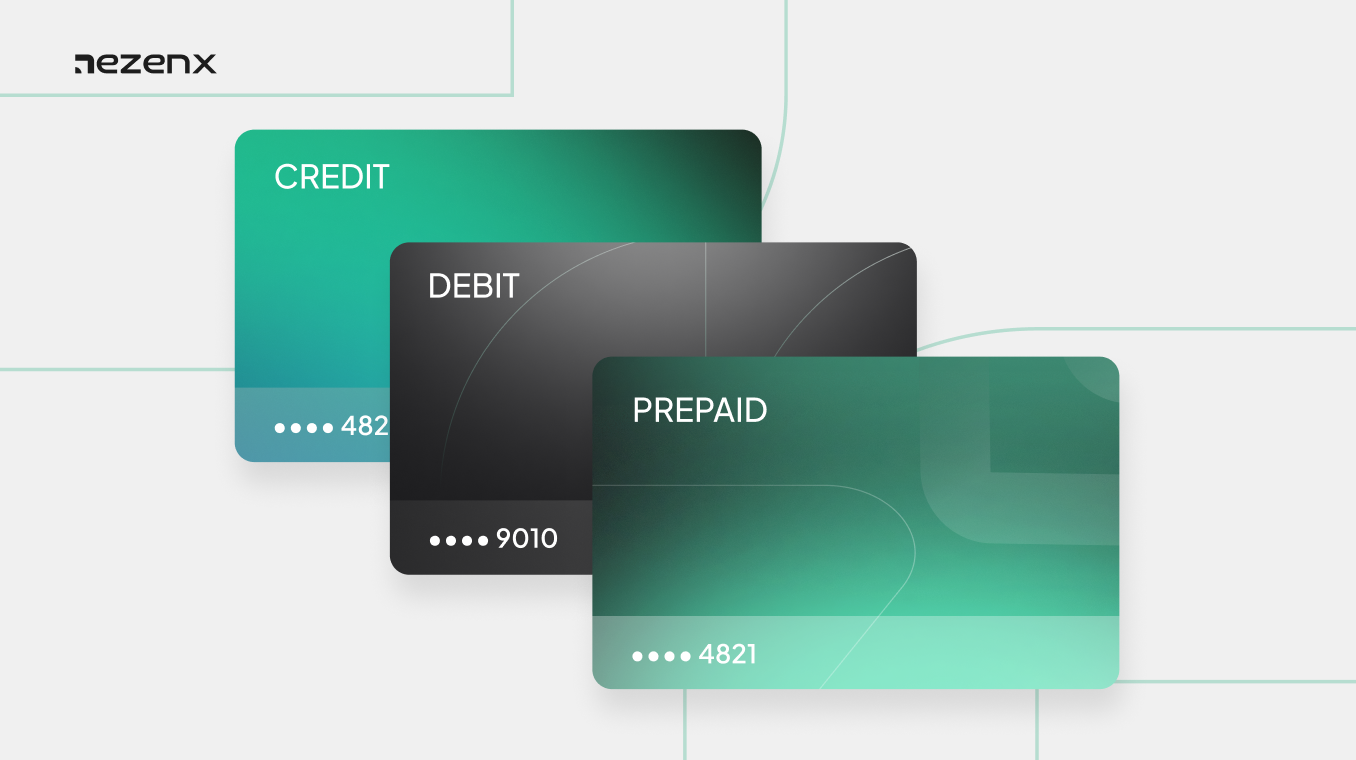
The right payment card can help cardholders manage spending in a way that fits their cash flow. How the card is funded matters: some use available funds, while others provide access to credit that must be repaid. These differences affect when payment is made, spending limits, and the costs involved.
| Card Type | Funds used | When it’s paid | Spending limit | Interest |
|---|---|---|---|---|
| Debit card | Linked account balance | At purchase | Available balance | None |
| Prepaid card | Balance loaded in advance | Before purchase | Loaded balance | None |
| Credit card | Revolving credit line | Later, in full or over time | Credit limit | Generally charged on balances carried forward |
| Charge card | Short-term credit | Later, in full | Often no preset limitᵃ | None if paid in full on timeᵇ |
ᵃ No preset limit does not mean unlimited spending; purchases remain subject to the issuer’s assessment.
ᵇ Late payment can result in fees. Some charge card programs allow eligible purchases to be paid over time with interest.
Prepaid and stored-value cards both involve funds paid in advance, and the terms are sometimes used interchangeably. Some sources distinguish them by where the balance is recorded: a prepaid card accesses a balance held in the issuer’s system, while a stored-value card can hold value on the card itself and is often anonymous.
An ATM card is named for its function rather than its funding source. Many debit and credit cards also offer ATM access, while an ATM-only card is limited to those services.
For businesses, the difference shows up in timing. A prepaid balance can be set aside for a project or employee before spending begins, keeping expenses within a defined budget. Credit and charge cards provide time between a purchase and repayment, giving businesses more flexibility to manage cash flow. Cardholders still need to plan for the payment due and any interest or fees.
Specialized Business & Institutional Cards
Beyond how a card is funded, businesses and public organizations also need to consider how it will be used. Routine purchases, vehicle expenses, and business travel have different spending requirements. Specialized cards provide controls tailored to each purpose.
Purchasing cards (P-cards) allow employees to pay for business purchases such as office supplies and operational goods. For routine, low-value expenses, they reduce administrative work by limiting the need for a separate purchase order for every transaction.
Fleet and fuel cards are used for vehicle-related expenses, primarily fuel. Some programs also cover maintenance. Spending limits and purchase restrictions help prevent unauthorized use, while transaction records help organizations identify unusual spending across the fleet.
Business travel cards cover work-related expenses such as flights, accommodation, and meals. Dedicated cards separate these expenses from personal spending, giving employees and finance teams a clearer view of travel costs.
Card Networks: Global Acceptance vs. Domestic Schemes
A card network, also called a card scheme, connects the parties involved in a card payment and sets rules for how transactions are processed. When a customer pays, the network passes transaction data between the card issuer and the merchant’s payment processor.
Card networks generally fall into two groups based on where they operate: international, and domestic or regional.
International networks such as Visa, Mastercard, UnionPay, American Express, and JCB are accepted across many countries. Their reach supports cross-border transactions, although acceptance varies between merchants and markets.
Domestic and regional networks focus on specific markets. Examples include Cartes Bancaires in France, Elo in Brazil, and Bancontact in Belgium. For businesses entering these markets, accepting international cards alone may not be enough: a customer whose card operates only on a domestic network cannot pay at a checkout that does not support that network.
Some cards carry two or more networks, which can include both a domestic and an international network. These are known as co-badged cards. For example, a card with Cartes Bancaires and Visa can be used at merchants that accept either network, giving the cardholder more places to pay, including abroad. For merchants, the network used to process a payment can affect fees.
The Lifecycle of a Transaction & Fundamental Security
A card payment may take only a few seconds at checkout, but more happens behind the scenes. For cardholders, this process explains why a pending charge appears; for businesses, it shows what happens before the money arrives.
Card payments often follow two main steps:
- Authorization: The card issuer checks the transaction and decides whether to approve it. If approved, the amount is placed on hold, reducing the cardholder’s available funds or remaining credit. This hold may appear as a pending transaction in the cardholder’s banking app.
- Capture: The merchant requests the approved payment. The transaction then moves toward settlement, when funds are transferred to pay the merchant.
Capture can happen soon after authorization or later. For example, an online store may authorize a payment when an order is placed and capture it when the order is ready to ship. If the payment is not captured within the allowed period, the hold is released.
Security measures also work alongside these steps, especially online. 3D Secure 2 (3DS2) helps the issuer confirm that the person making the purchase is the cardholder. Many checks happen in the background; in other cases, the customer may be asked to enter a one-time password (OTP) or confirm the purchase in a banking app. For merchants, successful authentication can also shift liability for certain fraud-related chargebacks to the issuer.
While 3DS2 helps verify who is paying, tokenization protects the card details themselves. It replaces the card number with a digital token, which can be restricted to a specific device or merchant, making it harder to misuse elsewhere if exposed. Digital wallets and some other electronic payment methods use tokens to limit the sharing of the actual card number during payment.
* This article is provided for general informational purposes only and does not constitute professional advice of any kind.
We make reasonable efforts to provide complete and accurate information. The content reflects the sources available at the time of publication and may be updated as necessary.
You should conduct your own research or consult an appropriate professional before making decisions based on your specific needs.
By accessing and using this website, you agree to comply with our Terms of Service. Content on this website is owned by NezenX and is developed and reviewed in accordance with our Editorial Guidelines.