ACH Payments Explained: Meaning, Network Mechanics, and Types

NezenX Team
Receiving a payment notification but having to wait a day or two for the funds to actually reach your account is a familiar experience for anyone who uses ACH. As a traditional, low-cost way to move money, ACH still has its place, but it struggles to keep up with urgent disbursements or real-time transactions.
This article breaks down how ACH works, helping you understand where it fits as a cost-effective payment method and when your business needs instant payments instead.
ACH Payment Meaning & Core Infrastructure
To understand the ACH payment meaning, ACH (Automated Clearing House) is a nationwide electronic payment network in the United States that processes billions of ACH payments every year. The system enables financial institutions to exchange credit and debit transfer instructions in batches, rather than processing each instruction individually. ACH reaches nearly all bank and credit union accounts across the country.
The network operates through a clear division of responsibilities:
- Nacha: A nonprofit, membership-based organization responsible for developing, updating, and overseeing compliance with the Operating Rules across the network, including the authority to impose penalties for violations.
- Two ACH Operators: These serve as the network's central clearing facilities and comprise the Federal Reserve Banks, which provide the public-sector FedACH service, and the Electronic Payments Network (EPN), operated by the private-sector organization The Clearing House. Because the two operators exchange data files, a financial institution only needs to connect to one operator to transact across the entire network.
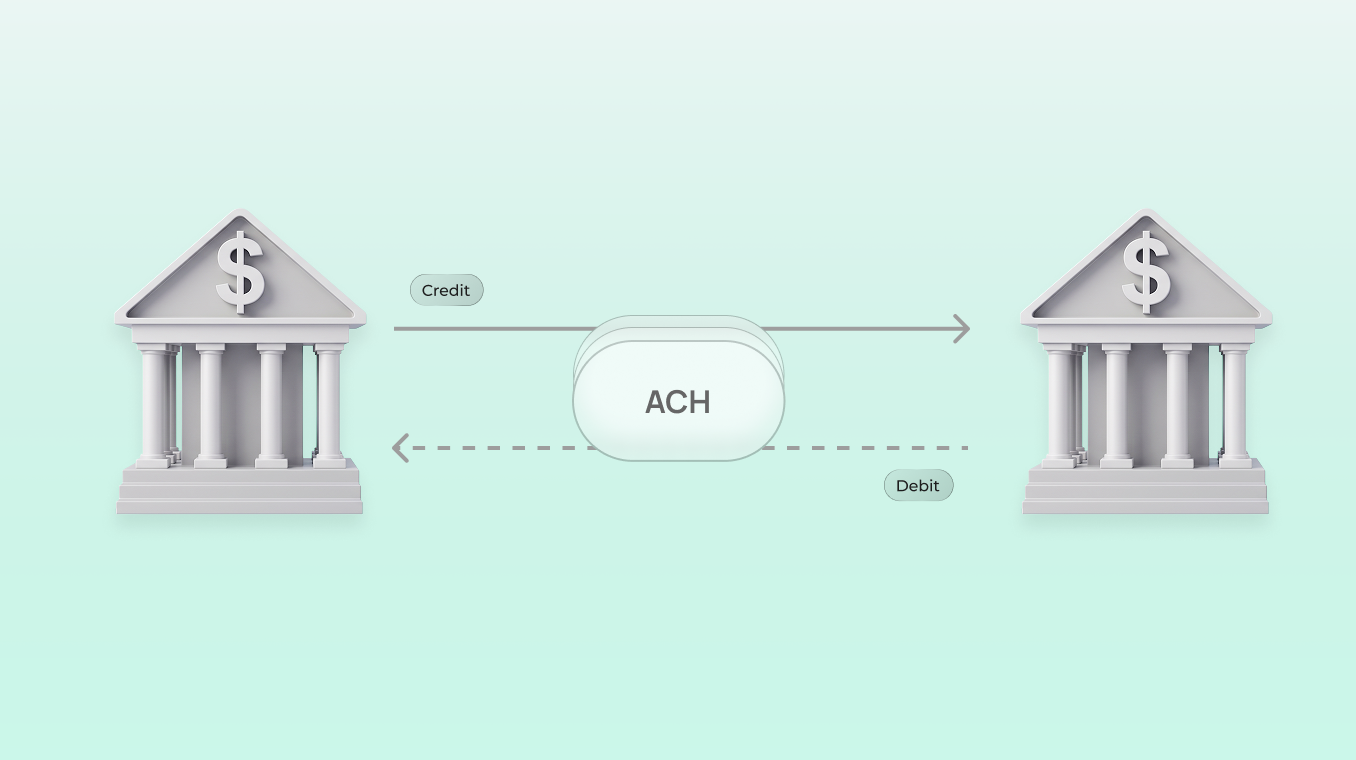
ACH Transaction Types: ACH Credit vs. ACH Debit
Depending on which party initiates the transaction, ACH transactions are divided into ACH Credit and ACH Debit.
ACH Credit (Push)
An ACH Credit is initiated by the payer, who instructs their financial institution to send funds to the payee's account. Because the payer controls the amount and timing of the payment, the payee only needs to provide their account details and does not need to authorize a debit. In return, the payer should check the payment details carefully before sending, as reversing a payment sent in error is subject to specific rules and time limits. ACH Credit is commonly used for payroll direct deposits, tax refunds, and vendor payments.
ACH Debit (Pull)
An ACH Debit is initiated by the payee to pull funds from the payer's account. Under Nacha rules, this requires prior authorization from the account holder. The account holder has the right to dispute unauthorized debits, while the payee bears the risk of the transaction being returned if the payer's account has insufficient funds. ACH Debit is commonly used for automatic bill payments (autopay) and monthly subscription fees.
ACH Payment Processing: Workflow & 5 Key Participants
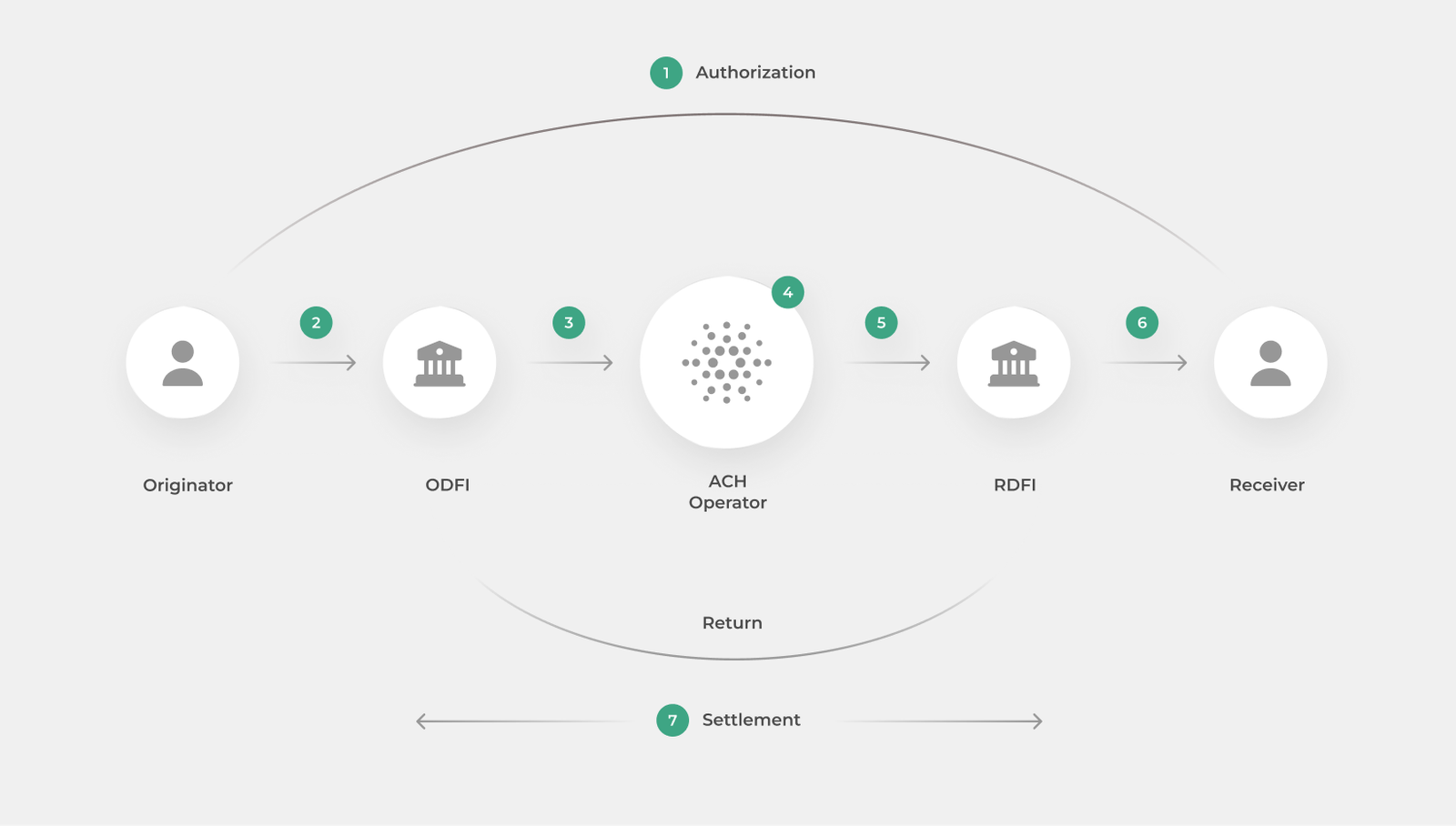
An ACH transaction involves five parties. The Originator initiates the transaction through the Originating Depository Financial Institution (ODFI). The Receiver is identified in the Entry and holds an account at the Receiving Depository Financial Institution (RDFI). The ACH Operator acts as the intermediary connecting the two financial institutions.
The Automated Clearing House (ACH) payment process works through the following key steps:
- The Receiver authorizes the Originator to initiate an Entry to the Receiver's account.
- The Originator submits a payment instruction to the ODFI. This instruction is formatted as an Entry by the Originator, the ODFI, or a third-party service provider. Each Entry contains the Receiver's account number, the receiving financial institution's routing number, the amount, and the date on which the Originator intends settlement to occur (Effective Entry Date).
- The ODFI groups Entries into an ACH file and submits it to the ACH Operator during scheduled processing windows throughout the day.
- The ACH Operator sorts Entries by receiving financial institution. The two ACH Operators also exchange files with each other.
- The ACH Operator distributes Entries to each RDFI based on target distribution times.
- The RDFI posts each Entry to the Receiver's account as a credit or debit. Within the applicable time limit, the RDFI may send a Return Entry to the ODFI through the ACH Operator.
- The ACH Operator performs settlement functions for the participating financial institutions.
The diagram below illustrates the visual workflow of ACH payments:
Because Entries are posted at the RDFI, recipients outside the United States need USD account details at a financial institution participating in the ACH Network to receive payments. One common option is to open a Global Multi-Currency Business Account in the business's own name. The account comes with a U.S. account number and routing number, making it easier to receive and send ACH payments with cost-efficient processing and competitive exchange rates.
ACH Transfer Times & Processing Costs
Processing Time
How long an ACH payment takes depends mainly on the processing option a business chooses, Standard ACH or Same Day ACH.
Under Standard ACH, Nacha sets settlement at 1–2 banking days for Credits and same-or next-day for Debits. In reality, processing often takes 1–3 business days (or up to 5), depending on transaction type, risk management procedures, cutoff times, holidays, and weekends.
For time-sensitive payments, Nacha also offers Same Day ACH, which allows both credits and debits to be cleared and settled within hours on the same business day. While it is not an instant payment, it helps businesses handle payments that fall due the same day.
Transaction Costs
For businesses, each Standard ACH transaction is estimated to cost around USD 0.05–5, depending on the bank or payment provider. Some providers also charge monthly gateway or batch-file fees. For Same Day ACH, the ODFI pays the RDFI an additional fee known as the Same Day Entry Fee.
While ACH fees are typically fixed regardless of the transfer amount, payment card processing fees include a percentage-based fee and a fixed fee, with different rates applying to credit and debit cards. For a USD 10,000 B2B transaction, card processing costs can reach USD 260–350, while ACH fees remain just a few dollars.
ACH payments can therefore help optimize the cost structure of B2B payments and large recurring financial obligations, provided businesses can accommodate settlement times ranging from a few hours to several days. In the context of business operations, however, the most cost-effective solution is not always the best choice. Corporate Cards support instant transaction completion, incorporate role-based permissions and secure spending limit controls, making them an ideal complement for routine operating expenses, software purchases (SaaS), and operational spending that requires real-time processing.
ACH Transfers vs. Wire Transfers vs. Instant Payments (FedNow & RTP)
ACH, wire transfers, and instant payments each offer a different balance of speed, cost, and transaction reversibility. ACH is a cost-effective option, though settlement takes time. Wire transfers meet the need for same-day funds at a higher cost. Instant payment networks such as FedNow and RTP stand out for their ability to settle payments within seconds, 24/7, including weekends and holidays. Beyond sending payments, businesses can also prompt incoming payments through Request for Payment functionality.
| Criterion | ACH | Wire Transfers | Instant Payments (FedNow / RTP) |
|---|---|---|---|
| Settlement speed | 1–2 banking days (Standard); a few hours within the same day (Same Day) | Same day | Instant, within seconds |
| Operating hours | Banking days only | Banking days only | 24/7/365, including holidays and weekends |
| Cost per transaction* | USD 0.05–5 (Very low) | USD 10–30 (Higher cost) | USD 0.30–7 (Moderate cost) |
| Payment direction | Push (Credit) and Pull (Debit) | Primarily Push (Credit) | Push (Credit), with Request for Payment functionality |
| Reversibility and returns | Returns or reversals permitted within applicable time limits | Irrevocable | Irrevocable; a request for return may be submitted |
| Best-fit use cases | Payroll, recurring bills, and cost-efficient payments | High-value transactions requiring same-day funds | Instant cash flow, urgent disbursements, and proactive collections |
*Costs are estimates per domestic transaction. Actual fees depend on the bank or service provider.
Security, Reversals & Return Codes
For data security, Nacha requires all transactions transmitted over unsecured electronic networks, such as the Internet, to be encrypted using commercially reasonable technology. Alongside data protection, Originating Depository Financial Institutions (ODFIs), non-Consumer Originators, and third-party processing service providers must establish risk-based monitoring processes to detect fraudulent ACH transactions. Receiving Depository Financial Institutions (RDFIs) must also apply similar controls to incoming ACH credits.
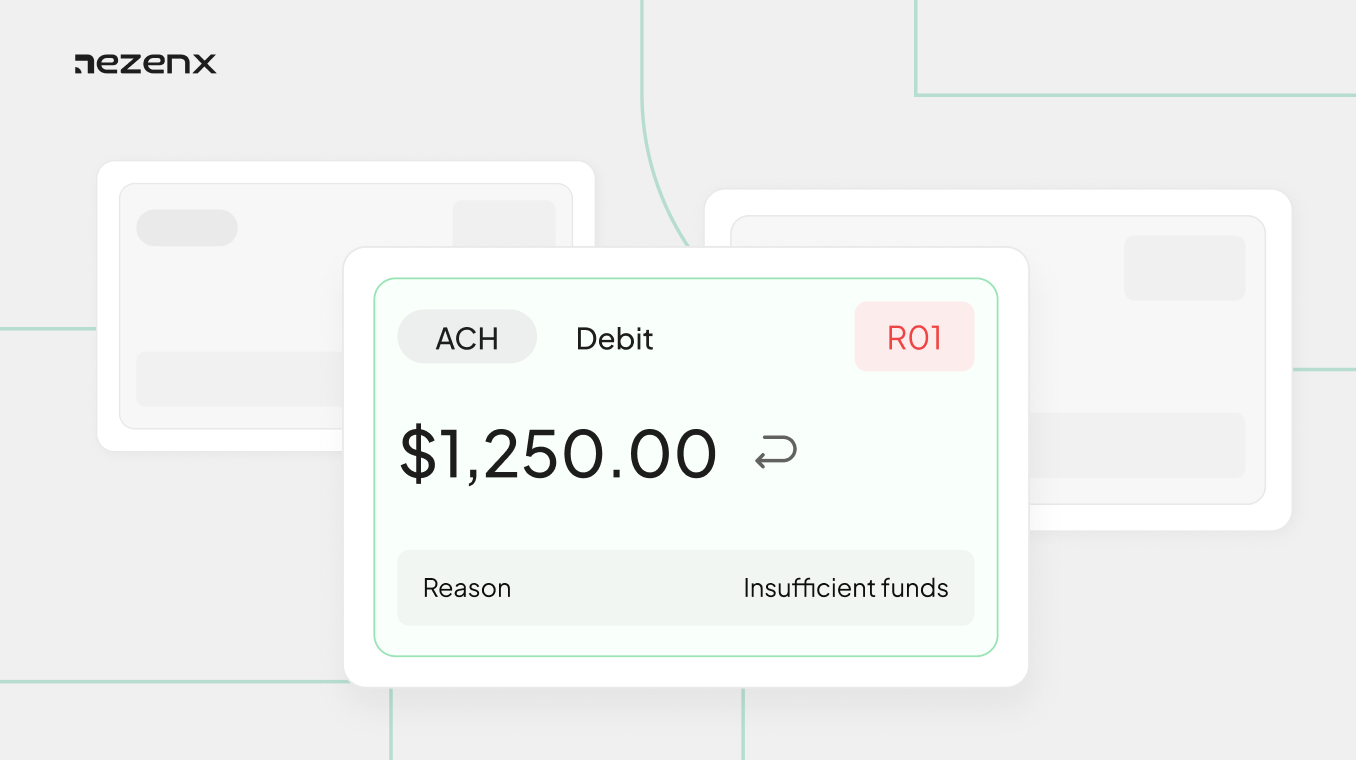
When a transaction needs to be returned, the RDFI sends a Return Entry with an ACH Return Code, such as R01 (Insufficient Funds) or R02 (Account Closed). The meanings and applicable time limits for individual codes are summarized in the ACH return code table. The standard return window is two banking days following the settlement date. For ACH debits to consumer accounts, the return window extends to 60 calendar days when the account holder provides a written statement confirming that the debit was not authorized.
When an error originates on the sending side, such as a duplicate payment, an incorrect recipient or amount, or a debit processed earlier than intended, the Originator or ODFI may initiate a reversal within five banking days following the settlement date. In addition to Nacha rules, transactions involving consumer accounts are subject to Regulation E, administered by the Consumer Financial Protection Bureau (CFPB). Account holders must notify their bank of an unauthorized debit within 60 days after the bank sends the first statement showing that transaction. If notification is late, the account holder may be liable for unauthorized transactions occurring after that period and before notification, provided the bank establishes that timely notification would have prevented them.
Conclusion
ACH is a widely used, low-cost infrastructure for batch payments in the United States, supporting both ACH Credit (push payments) and ACH Debit (pull payments). Although Same Day ACH has shortened processing times to a few hours, ACH generally remains slower than instant payments. In return, it offers lower costs and mechanisms for returning or reversing transactions when errors occur.
When choosing a payment method for your business, consider three factors: settlement speed, cost per transaction, and the ability to reverse a transaction when errors occur. If your business is looking for local USD account details for ACH collections and payments, explore Global Account combined with Smart Funding to take control of liquidity and manage incoming and outgoing funds.
* This article is provided for general informational purposes only and does not constitute professional advice of any kind.
We make reasonable efforts to provide complete and accurate information. The content reflects the sources available at the time of publication and may be updated as necessary.
You should conduct your own research or consult an appropriate professional before making decisions based on your specific needs.
By accessing and using this website, you agree to comply with our Terms of Service. Content on this website is owned by NezenX and is developed and reviewed in accordance with our Editorial Guidelines.